
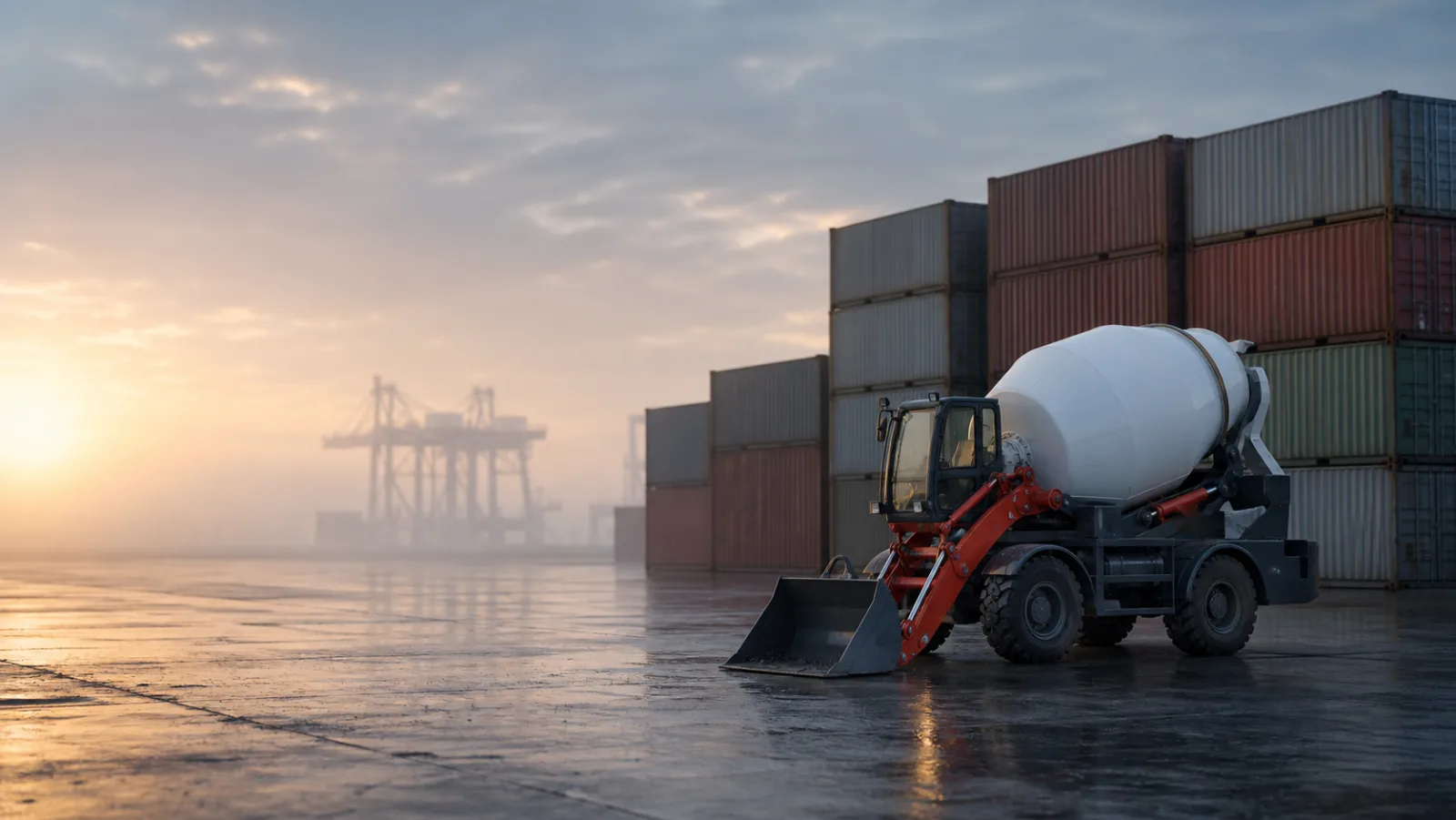
Shipping · container loading
Shipping a self-loading concrete mixer: what fits a container, and what does not
A 40 ft high cube gives you 2.698 m of internal height and a 2.585 m door. Take a handling margin off that and you are loading through an opening 2.29 m wide by 2.535 m high. The door frame — not the roof — is what stops most self-loading mixers, and which side of it your machine falls on moves the freight bill far more than the specification does.
- 2.535 m
- Usable door height, 40HQ
- 2.29 m
- Usable door width, 40HQ
- 2 of 6
- Models with a measured drawing
The mechanism
The door frame, not the internal height
What blocks a machine from a container is the door frame, not the internal height.
Internal height is measured to the roof, in the middle of the box. The doorway is framed by the header, the sill and the two corner posts, so the opening is always smaller than the space behind it. On a 40 ft high cube the difference is 113 mm — height that is on the specification sheet and can never be used.
Then take a working margin. The machine goes in on its own tyres or on a winch, over a sill, with someone standing clear and the lashing points still reachable down both sides. Fifty millimetres off each critical dimension is the allowance loading crews actually work to. That leaves 2.29 m wide by 2.535 m high on a high cube, and 2.29 m by 2.23 m on an ordinary 40 ft or 20 ft box.
So a machine quoted at 2.55 m tall “fits inside” a high cube on paper and still never gets through the door. That is the most common reason a machine that looked like a container load turns into a flat-rack booking after the price has been agreed — and the reason the mode is fixed before we quote, not after.
- Internal height
- 2.698 m
- Door opening
- 2.585 m
- Usable after margin
- 2.535 m
- SLM-18 front outline
- 2.21 × 2.58 m
| Container | Internal L × W × H (m) | Door W × H (m) | Usable after 5 cm margin (m) | Payload limit (t) |
|---|---|---|---|---|
| 20GP | 5.898 × 2.352 × 2.393 | 2.343 × 2.28 | 2.293 × 2.23 | 28 |
| 40GP | 12.032 × 2.352 × 2.393 | 2.34 × 2.28 | 2.29 × 2.23 | 26.5 |
| 40HQ | 12.032 × 2.352 × 2.698 | 2.34 × 2.585 | 2.29 × 2.535 | 26.5 |
- Above the door header, unusable
- 113 mm
- Handling margin
- 50 mm
- SLM-18 over the usable limit
- 45 mm
The number that decides
Three heights, and only one of them decides
Brochures quote whichever of these is most flattering. They are not interchangeable, and only the third one has anything to do with a container.
- Working height
- The drum or the loading bucket at full lift. It is the biggest number on the brochure and it has nothing to do with shipping.
- Travelling height
- The machine standing on its tyres in its normal carrying position. This is the front elevation on the general-arrangement drawing, and it is the figure we publish in the specification tables.
- Shipping height, drum lowered
- The drum dropped as far as it goes for transport. The drum on these machines lifts and rotates through 270°, so the transport posture can sit below the travelling posture — sometimes by enough to change the mode.
- Working height (drum raised)
- 3.45 m
- Travelling height, on its tyres
- 2.58 m
- Shipping height (drum lowered)
- not confirmed
Modes
Four ways a mixer travels
Which one you are on is decided by two numbers, in this order: width first, then height.
40HQHigh-cube container
A sealed 40 ft high-cube box. Standard lifting gear at both ends, no special handling, and the machine is out of the weather and out of sight for the whole voyage.
- When it applies
- The machine clears 2.29 m wide × 2.535 m high with the drum down, and the load stays inside the 26.5 t payload limit.
- What to watch
- When two machines share one box, the cost per unit falls sharply. In our range one model is measured to do that; for the rest we will not claim it until the lowered-drum height is confirmed in writing.
40FRFlat rack
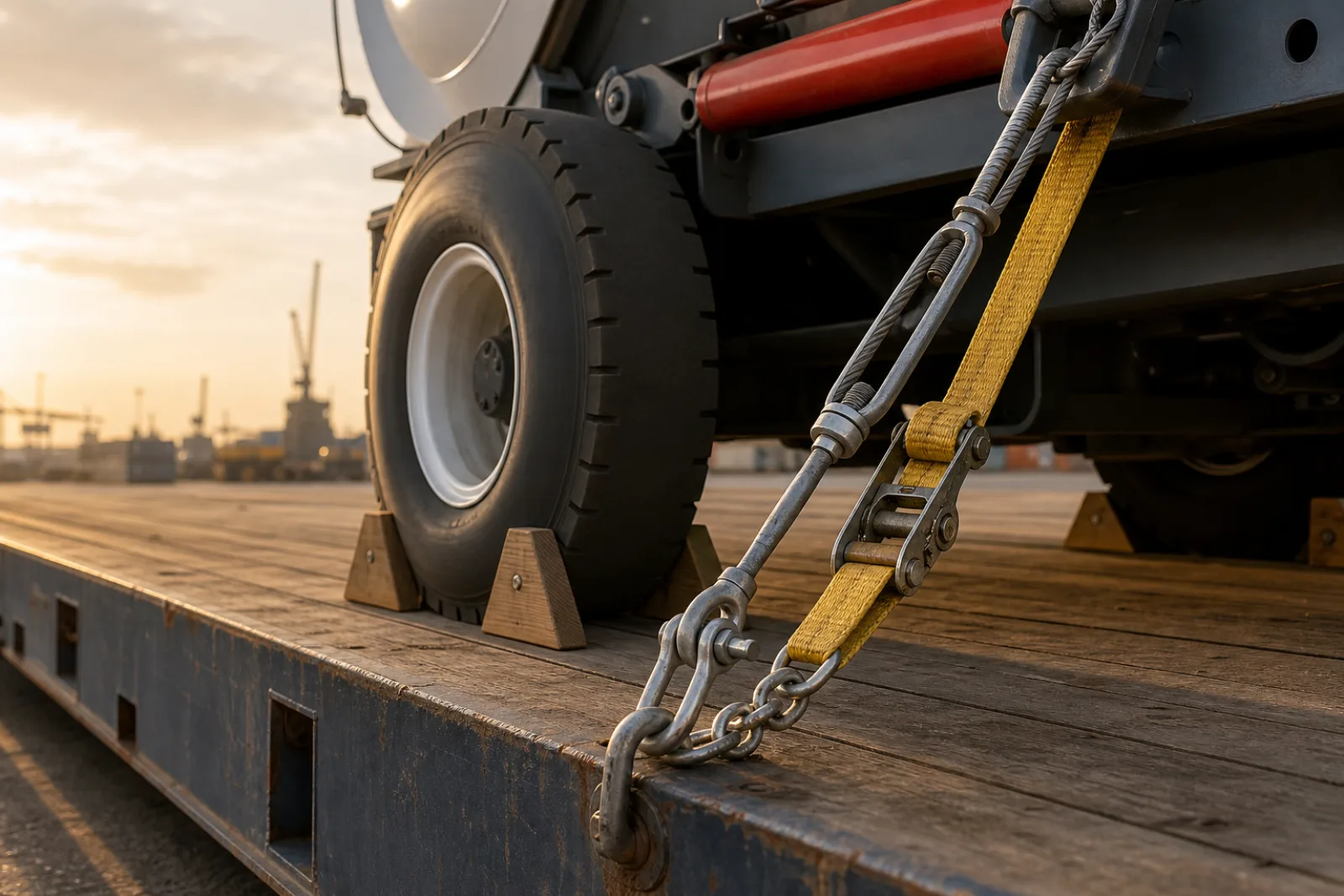
A container-sized steel platform with end walls and no sides or roof. The machine sits on the deck and is chained down.
- When it applies
- Over-width, over-height, or both. This is where most self-loading mixers sit today.
- What to watch
- Priced as out-of-gauge cargo, booked earlier than a box, lifted by crane at both ends, and exposed for the whole voyage — we wrap the cab and grease bright surfaces before it leaves the plant.
40OTOpen top
Container walls and floor with a removable tarpaulin roof and a swinging door header. The machine is lifted in from above rather than driven through the door.
- When it applies
- Over-height only, and within the width — loading from the top takes the door header out of the argument.
- What to watch
- It answers the header, not the walls. And a crane has to be available at both ends: a yard with nothing but a reach stacker cannot lift a machine out of the top of a box.
RoRoRoll-on, roll-off
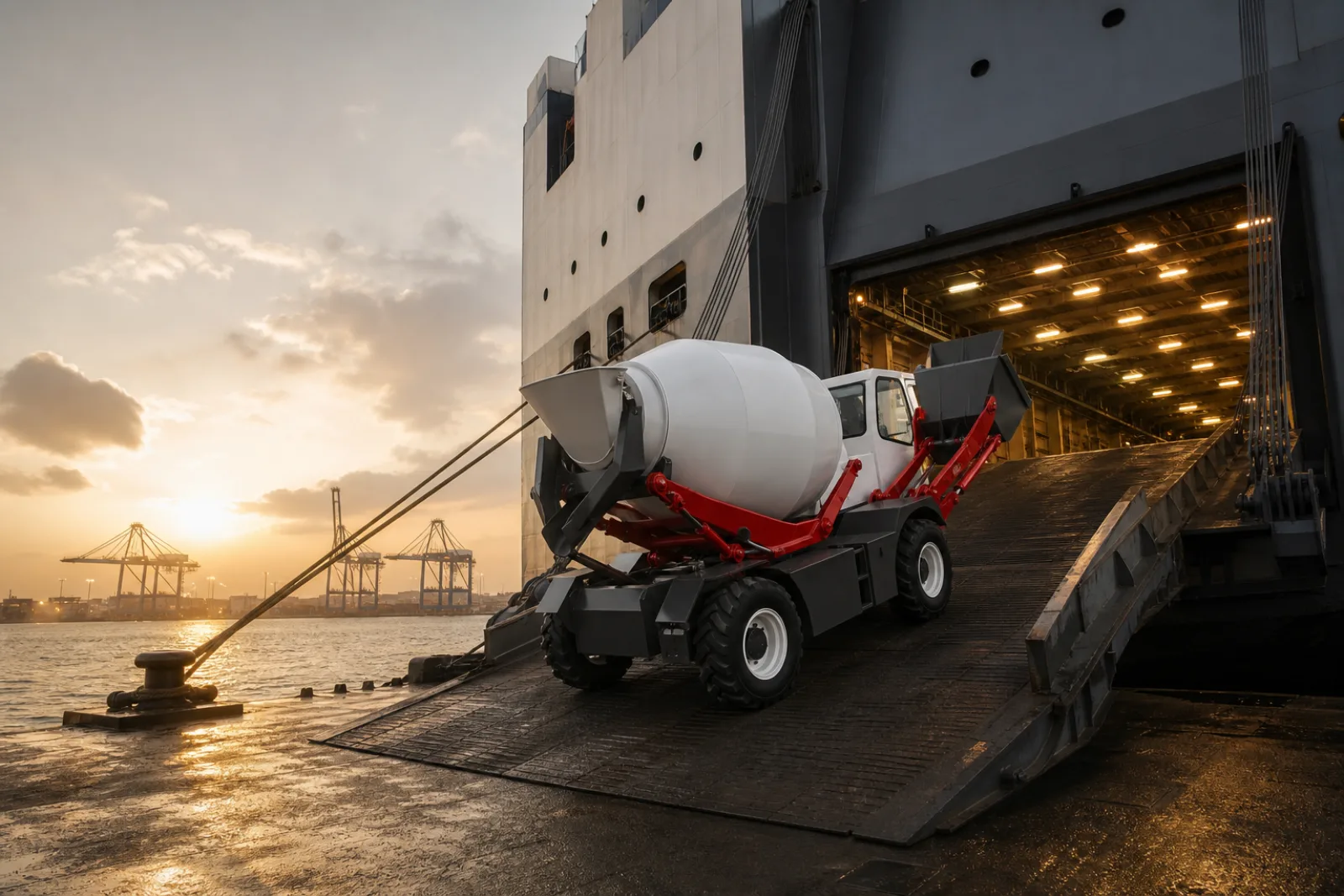
The machine is driven or towed on and off the vessel over a ramp. No box, no crane, no lifting points to worry about.
- When it applies
- Self-propelled machines that are over-height and over-width, or lanes where a suitable out-of-gauge slot is hard to get.
- What to watch
- Charged on a weight-or-measure basis rather than per box, sails on fewer services and into fewer ports, and needs somebody licensed and insured to drive it off at your end.
Breakbulk — lifted aboard as a single piece and stowed in the hold — stays the fallback where none of the four work, and it is how the heaviest tracked machines usually move.
Model by model
Every model, and what it is measured to do
Two of these six machines have a dimensioned general-arrangement drawing that we have measured through the door frame. Four do not. We would rather show you which is which than fill the column in.
| Model | Discharge | Travelling L × W × H | Door-frame check | Mode |
|---|---|---|---|---|
| SLM-10 | 1.0 m³ | 4.35 × 1.6 × 2.45 m | Clears the door frame — 2 units per 40HQ | 40HQ |
| SLM-18 | 1.6-1.8 m³ | 7.06 × 2.21 × 2.58 m | Measured — 45 mm over the usable door height | Flat rackOpen topRoRo |
| SLM-24 | 2.4 m³ | Not supplied | Not yet measured — quoted out of gauge | Flat rackOpen topRoRo |
| SLM-35 | Not supplied | Not supplied | Not yet measured — quoted out of gauge | Flat rackOpen topRoRo |
| SLM-40 | 3.8-4.0 m³ | Not supplied | Not yet measured — quoted out of gauge | Flat rackOpen topRoRo |
| SLM-45 | 4.0-4.5 m³ | Not supplied | Not yet measured — quoted out of gauge | Flat rackOpen topRoRo |
- “Not yet measured” means exactly that: the plant has not sent a dimensioned drawing, so the machine is quoted out of gauge. Name a model and we get the drawing before the quotation goes out, not after it.
- Payload is checked against the container limit as well as the opening. A machine that clears the door can still be too heavy for the box, and the weight that matters is the one the plant confirms in writing.
At the other end
What happens at your port
The mode you book decides what your yard has to be able to do on the day. These are the five questions worth settling before the booking, not after the vessel berths.
- Lifting it off
- A flat rack or an open top has to be lifted. Ask your yard for the crane capacity and the reach it can actually give you on the day, and give them the machine’s operating weight plus the rack, not the machine alone. Where a plant has not confirmed a weight in writing, this site leaves the figure out rather than putting a guess into your lift plan.
- Driving it off
- Roll-on, roll-off needs no crane, but the terminal has to accept a self-propelled unit and somebody has to be licensed and insured to move it off the quay. That person is arranged before the vessel arrives, not on the day it does.
- Taking parts off to make it fit
- A bucket arm, a chute or a canopy can be removed to get a machine under a door frame. It is a real option and it is not free: the parts have to be refitted and recommissioned at your end, hydraulic circuits opened and bled, fasteners torqued to specification — and any transit damage becomes a three-way argument between the yard, the carrier and the plant. If anything comes off, it is photographed, listed on the packing list as a separate piece, and the refitting procedure travels in the box.
- Check the rules before you cut
- In some markets shipping in parts is expressly permitted where transport dimensions make whole-unit import impossible, provided each part is shown to belong to a certified model. In others, changing the configuration changes what you declared on the certificate. Settle that with your customs broker first — it is a compliance question, not a rigging one.
- The road after the port
- The machine that cleared the ship still has to clear the route to site: overpass and bridge heights, permit rules for over-width loads, and whichever low-loader is actually available locally. That side of the line is yours, and it is worth checking before the container mode is fixed rather than after.
Certificates, classification and who files what: Compliance →
Questions we get asked before a booking
How many self-loading concrete mixers fit in a 40 ft container?
It depends on the width and on the height with the drum lowered, and it is decided by the door opening rather than by the internal height. In our range one model is measured through the door frame and loads two units per 40HQ. Every other model is quoted flat rack, open top or roll-on roll-off until the plant confirms its lowered-drum height in writing.
Can a machine that is over-height still travel in a container?
Sometimes, in an open top, because it is lifted in from above rather than driven through the door. Over-width is different: the internal width of a standard box is 2.352 m and nothing changes that, so an over-width machine goes on a flat rack or by roll-on roll-off.
What is the difference between a flat rack and an open top?
An open top is a full container with a removable roof: walls, floor and a door, loaded from above. A flat rack is a platform with end walls and no sides at all, so it also takes over-width cargo. An open top protects the machine better; a flat rack takes more of it.
Is roll-on roll-off cheaper than a container?
It depends on the lane and the sailing. Roll-on roll-off is charged on a weight-or-measure basis rather than per box, and it removes the crane at both ends, but it runs on fewer services and into fewer ports. We quote the mode together with the landed cost for your port rather than publishing a freight figure, because ocean rates move per sailing and a number printed on a web page would be out of date before you read it.
Can different models share one container?
Only if each of them clears the door opening and the combined weight stays inside the payload limit. Since one model in the range is currently measured to clear it, a mixed box is not something we can offer today. When the lowered-drum heights arrive from the plant, this page and the model table change with them.
Who arranges lifting at the destination port?
You do, or your customs broker does, and it is booked against the operating weight on the packing list. We tell you the mode, the weight we have in writing and the lifting points before the vessel sails, so the yard can confirm it can handle the piece rather than discovering it on arrival.
Guides
Read before you compare quotations
Longer pieces on the decisions that move a landed cost. Every figure in them names its source; what could not be sourced is listed at the end of each one.
Shipping
Concrete mixer truck dimensions, measured: ten machines and the door they have to clear7 sections · 2026-09-24
Shipping
Which machines fit a 40 ft container: the door-frame test, applied to eleven11 sections · 2026-09-02
Compliance
8705.40 or 8474.31: one machine, two customs regimes, and who decides9 sections · 2026-09-02
Tell us the port, and we will tell you the mode
Give us a model and a destination port and you get the container mode, the documents required for your country and one landed figure — not a factory-gate price with the hard part left to you.